
I’m pulling a few current references on family-scapegoat and public-humiliation story arcs, then I’ll turn this into a full, emotionally satisfying ending in American English.
I’ve got the emotional spine now: the fallout isn’t really about the shoes, it’s about Rick refusing the role they assigned him. I’m shaping the ending so the 49 missed calls become the moment the family finally needs the one person they trained to disappear.
Thought for 3m 3s
I drove north with my phone vibrating in the cup holder like something alive and angry. By the time I hit the freeway, my mother had called eleven times, Madison seven, and there were three texts from numbers I didn’t recognize. One of them was from the club manager.
Sir, there seems to have been a misunderstanding.
That almost made me laugh.
At a red light, another message lit up the screen.
Mom: Come back right now.
Mom: Do not do this to me on my birthday.
Madison: Those shoes were fourteen hundred dollars. You insane, jealous loser.
Mom: Answer your phone.
Mom: People are asking questions.
That was the one that told me everything. Not Are you okay? Not Why did you leave? Not even What happened to you that made you finally snap?
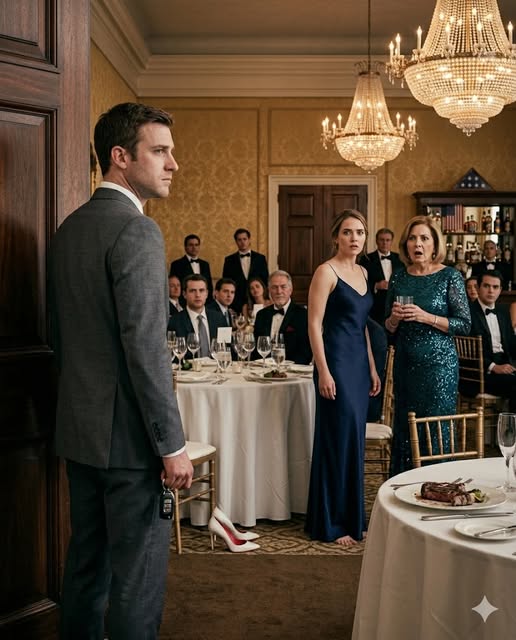
People are asking questions.
I put the phone face down and kept driving.
I spent that night in a motel in Ventura with an ice machine that groaned through the wall and a bedspread that smelled like bleach. I lay awake staring at the ceiling, waiting for the guilt to find me the way it always did. Guilt had been my family’s leash. They never even had to pull hard. A sigh from my mother, a sarcastic laugh from Madison, a reminder of “everything we’ve done for you,” and I’d come running with a toolkit, a credit card, a fake smile.
But that night something strange happened.
The guilt came.
And then it left.
In the morning I bought bad coffee, got back on the road, and drove to San Francisco.
The messages kept coming for three days.
First outrage.
Then insult.
Then revision.
By Sunday, my mother was acting like I had misread a harmless joke. By Monday, Madison was claiming she’d been “obviously kidding.” By Tuesday, my mother sent a paragraph about family loyalty that somehow never included the word respect. Then, just like that, silence.
No calls. No texts. No emergency. No fake warmth.
I should have felt abandoned. Instead, I felt air.
My apartment in the city had never looked especially beautiful to me before. It was a one-bedroom in Noe Valley with crooked hardwood floors and a radiator that clanked like it had opinions. But when I unlocked the door and stepped inside, it felt like the first honest room I’d ever lived in. No polished silver. No flower arrangements positioned for effect. No pressure vibrating under the surface of every sentence.
Just my keys in the bowl. My shoes by the door. My life exactly where I’d left it.
For the first week, I kept waiting for my body to understand that the crisis was over. I’d wake up at 5:00 a.m. with my jaw tight, heart pounding, sure I had forgotten something important. Buy the wine. Pick up Madison. Fix the centerpiece. Calm Mom down. Apologize first. Apologize even if you don’t know why.
At work, I stared too long at code I normally could have untangled in ten minutes. My manager, Priya, asked if I was sick. I almost said yes. It would have been easier than the truth.
The truth was that I didn’t know who I was when no one was demanding something from me.
A week later, I sat in a therapist’s office in Hayes Valley and spent forty minutes explaining my family like I was defending them in court.
My therapist, Elena, listened without interrupting. Then she folded her hands and said, “You keep describing mistreatment as if it becomes less painful because it was familiar.”
I looked at the rug.
Then I said the truest thing I’d said in years.
“I don’t know how to stop being useful.”
She nodded once, like I’d finally opened the right door.
The weeks after that were quiet in ways that felt almost suspicious. I went to work. I cooked for myself. I ran along the Embarcadero at sunset and realized I had no idea what kind of music I actually liked because for years I’d been listening to whatever kept me calm enough to handle the next family emergency.
I stopped checking my phone every ten minutes.
I stopped rehearsing imaginary arguments in the shower.
I started sleeping.
Then, twenty-three days after the party, I woke up on a Saturday to sunlight on my wall and forty-nine missed calls from my mother.
Forty-nine.
There were voicemails too. The first few sounded furious, tight with wounded pride.
“Richard, this has gone on long enough.”
“Your sister is going through something and your silence is cruel.”
“Whatever point you were trying to make has been made.”
Then the tone changed.
By voicemail twelve, she sounded shaken.
By twenty-three, she was crying.
By forty-nine, she didn’t sound like my mother at all. She sounded small.
“Rick, please. Please answer me. It’s Madison. She’s at Hoag. They said it wasn’t her heart, but she collapsed and they’re keeping her overnight because of the pills and the alcohol and the panic attack and I don’t—I don’t know what any of this means. Please call me. I can’t do this by myself.”
I sat up so fast the room tilted.
For a long time, I just listened to that last message again.
I wish I could tell you I felt vindicated. That some hard, ugly part of me smiled and thought, Now you know what it’s like when the strong one leaves.
But that’s not what happened.
What I felt was older than anger.
I felt twelve.
I felt the morning Dad left, when the house had seemed to split down the middle and my mother had chosen appearances over grief. I felt every night after that when Madison got to be dazzling and difficult and I got to be dependable because someone had to be. I felt tired in my bones. Tired enough to know that if I went back, I could not go back as the same person.
So I called.
My mother picked up on the first ring, breathless, as if she’d been holding the phone in her hand.
“Richard?”
“What happened?”
“She was at a luncheon. She stood up to speak and just—” My mother made a choking sound. “She couldn’t breathe. She fell. They said her blood pressure was sky high. She’d taken anti-anxiety medication and been drinking champagne and hadn’t eaten and apparently she’s been barely sleeping and—”
She stopped.
For the first time in my life, my mother sounded like someone standing in the wreckage instead of decorating it.
“I’m coming,” I said.
When I got to Newport Beach that night, the hospital room looked nothing like my memories of Madison. No perfect posture. No glossy hair arranged just so. No clever smile. She was in a pale gown with an IV taped to her hand, mascara ghosted under her eyes, skin the color of paper. She looked younger and older at the same time.
My mother stood when I walked in. She wasn’t wearing makeup. I had never seen her face so unguarded. It shocked me more than the hospital.
For a second no one spoke.
Then Madison turned her head on the pillow and looked at me.
Her voice came out scraped raw.
“You actually came.”
It wasn’t gratitude. It was disbelief.
I stayed near the door. “You collapsed.”
She gave a humorless laugh and winced from it. “That’s one way to put it.”
My mother moved toward me. “Rick—”
I took one step back.
Whatever she saw in my face made her stop.
The silence in that room was different from the silence at the country club. That one had been made of shock and humiliation. This one was stripped bare. No audience. No chandeliers. No polished version.
Just us, at last, with nowhere to hide.
Madison looked at the ceiling. “The doctor says I had a panic attack so bad my hands locked up. I thought I was dying.”
No one answered.
A minute later she said, “Ethan left.”
I didn’t recognize the name at first. Then I remembered. Her fiancé. Venture capital. Good jaw. The kind of man my mother described as “solid” because he wore expensive watches and spoke in low tones.
“When?” I asked.
“A week after the party.” She swallowed. “He said he was tired of every room feeling like a stage.”
That landed in the room like something heavy and true.
My mother sat down slowly.
Madison kept staring at the ceiling. “You want to know the funny part? I almost married a man who got tired of performing with us before I did.”
I looked at her, really looked, and for the first time I saw it clearly: Madison had always been cruel, yes. But she had also been conscripted. My mother turned pain into theater, and Madison had been handed the starring role at fifteen. She got applause. I got chores. Neither of us got to be children.
That didn’t excuse what she did to me.
But it explained the emptiness behind it.
My mother’s voice trembled. “I was trying to keep this family together.”
I turned to her so fast she flinched.
“No,” I said. “You were trying to keep it looking together.”
She opened her mouth, then closed it.
Tears filled her eyes, but I didn’t rush to comfort her. That was new too.
“When Dad left,” I said, “you decided the worst thing that could happen to us was being pitied. Not being hurt. Not being abandoned. Not learning how to talk to each other. Being pitied.” My throat tightened, but I kept going. “So Madison had to be perfect, and I had to be useful, and neither one of us got to be real.”
My mother sat very still.
Finally, in a voice so quiet I almost missed it, she said, “I knew you could handle more.”
Something inside me went cold.
“I was a kid,” I said. “Not a load-bearing wall.”
Madison covered her face with her good hand and started crying.
Not delicate crying. Not the kind she would have allowed at a funeral or in a bathroom with the door locked. This was broken, ugly crying, the kind that bends your body with it. I stood there and watched my sister grieve something neither of us had ever been allowed to name.
After a while she lowered her hand and looked at me.
“I hated you,” she whispered.
I didn’t move.
“Not because you were weak.” Her mouth shook. “Because you got to leave. You got to go build a life somewhere nobody knew us. And every time you came back, Mom would call you when things got practical, and she’d call me when things got public, and somehow I was still jealous of you.” She shut her eyes. “So I made you small whenever I could. Because if you stayed small, I didn’t have to look at what this did to me.”
The honesty of it hit harder than an apology.
Then she said the words I had wanted for years and no longer trusted enough to hope for.
“I’m sorry, Rick. Not for the shoes. For all of it.”
There is a version of this story where that apology fixes everything.
That is not the version that happened.
I believed she meant it. I also knew meaning it once was not the same as changing.
So I said the only true thing I had.
“I love you,” I told her. “But I am never doing this with you again.”
She nodded like she had been expecting that.
“I know.”
I helped that weekend, but differently.
I called nurses when my mother got overwhelmed instead of automatically taking over.
I picked up Madison’s discharge prescriptions, but when my mother tried to hand me a list of country club gossip to “manage,” I folded it once and put it back on the side table.
“No.”
She blinked at me.
“No explanations,” I said. “No spin. Let people think whatever they think.”
It was astonishing how revolutionary that little word felt in my mouth.
No.
At the house, the air had changed. It still smelled like lemon polish and money, but the performance was cracked. There were dishes in the sink. Flowers dying in vases. A throw blanket crooked on the couch. Signs of actual human beings.
Two days later, before I drove back to San Francisco, my mother found me on the back patio.
The same patio where I had stood with Madison’s heels in my hand.
She looked older than sixty then. Not ruined. Just real.
“I don’t know how to fix this,” she said.
“You don’t fix it,” I answered. “You stop pretending it isn’t broken.”
She stared at the pool for a long time. “I don’t know who I am without all of this.”
I almost said, Now you know how I felt.
Instead I said, “Then maybe that’s where you start.”
In October, she sold the house.
Not because of some dramatic downfall. Because she finally admitted she couldn’t afford the life she was defending so viciously, and because, for the first time, there was no point. Madison started therapy. Got a job with a small interior design firm in Laguna. Nothing glamorous. Real work, real hours, real consequences. The first time she told me about a difficult client, she laughed at herself before I could say anything.
We weren’t suddenly close. Healing would have made a prettier story. What we had instead was honesty, awkward and unfinished. Sometimes that’s better.
My mother called less. When she did, she asked instead of assuming. The first time she said, “Would Sunday work for you?” I had to sit down after we hung up.
The next spring, Madison came to San Francisco.
We walked along Ocean Beach in the cold wind, hands shoved in our pockets, saying things people should probably say sooner in life.
At one point she glanced down at my boots, scuffed from the sand, and smiled without malice.
“You know,” she said, “those are filthy.”
I looked at her.
She held up both hands. “I’m not asking.”
For a second we both just stood there with the waves coming in hard and gray beside us.
Then I laughed.
A real laugh. The kind that comes from somewhere deep enough to hurt on the way out.
When I got home that night, I set my boots by the door and stared at them for a moment. Salt on the leather. Sand in the seams. Marks from the day.
Then I sat down on the floor, took a cloth from the hall closet, and cleaned them myself.
Not because that was what I was good at.
Because they were mine.