
I’m pulling in a few similar betrayal-and-reckoning story patterns, then I’ll write a full ending in American English that stays emotionally intense and self-contained.
I’ve got the core pattern: public triumph, medical interruption, inheritance panic, and a reversal that forces the ex to confront what he destroyed. Now I’m shaping it into a full ending that lands emotionally instead of just delivering a twist.
Thought for 2m 29s
“Before you celebrate,” the head nurse said, glancing down at the chart and then back up at James, “there’s a complication with the legal paperwork. The prenatal paternity report in the patient’s file excludes you as the biological father.”
For one long second, nobody in that hallway seemed to understand English.
Margaret’s hand froze in the air, still hovering near the blue blanket. James gave a laugh so sharp and unnatural it sounded more like a choke.
“What?”
The nurse did not flinch. She had probably spent years delivering news people didn’t want. “Ms. Lily Evans consented to a noninvasive prenatal paternity test at thirty-two weeks. The result was placed under restricted release in her file. Because your name was submitted for the birth certificate and financial authorization, administration is required to inform you that the test indicates you are not the father.”
The envelope of cash slipped from James’s hand and hit the floor.
Margaret looked from the nurse to Lily’s room as if the walls themselves had betrayed her. “That’s impossible,” she whispered. Then louder, with all the fury of a woman whose pride had just been ripped open in public, “That is impossible.”
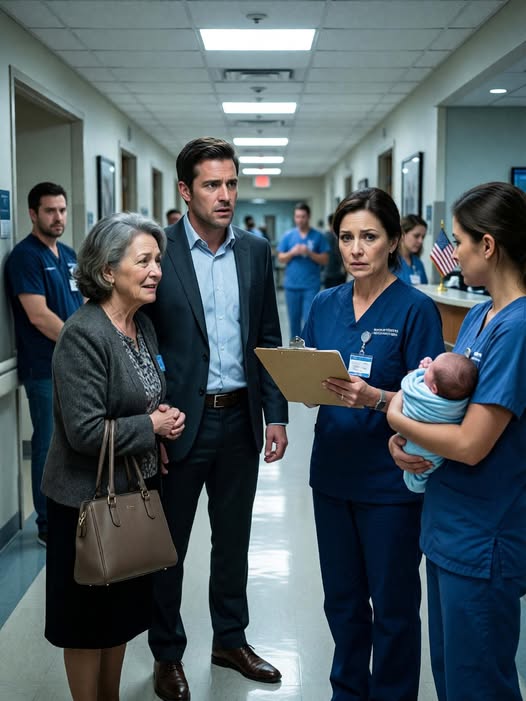
James stepped forward so quickly one of the other nurses moved in front of the baby’s bassinet. “You’re wrong,” he snapped. “There’s a mistake. Run it again. Call whoever did it. I paid for the best care in this city.”
“The lab already confirmed the findings,” the head nurse replied. “And there is no basis for listing you as the father unless further legal testing is done after birth.”
By then, people at the far end of the hall had stopped pretending not to listen. A man in a gray coat lowered his coffee cup. Two women near the elevator stared openly. Somebody’s phone screen glowed.
The private maternity ward James had chosen because he wanted discretion had suddenly become a stage.
The delivery room door opened.
Lily was being wheeled out, pale and sweating, her hair plastered to her temples. She looked weak, exhausted, and for half a second almost human enough to pity. Then she saw their faces and knew.
“Lily,” James said.
Just her name. Nothing more. But my friend later told me the way he said it made everyone around them take a step back.
Lily swallowed. “James, listen—”
“No,” Margaret cut in, voice shaking with rage. “You listen. You trapped my son. You destroyed his marriage. You put this family through scandal, and for what?”
Lily’s mouth trembled. “I thought—”
“You thought what?” James barked. “That I’d never find out?”
Her eyes filled, but not with innocence. With panic. With calculation breaking down under fluorescent lights.
“It was one time,” she whispered. “Before you and I were official. I didn’t know for sure. Then when I got pregnant, your mother kept talking about heirs and names and trust accounts, and you were so happy, and—”
“And you let me divorce my wife for this?” he said.
That was the moment, my friend said, when the whole hallway changed.
Not because he had finally been humiliated. Not because Margaret looked as if someone had dragged the family name through broken glass.
Because for the first time, James sounded like a man hearing himself.
His wife.
Not “Sophia.”
Not “the barren one.”
Not the woman who knew the house and could come help like hired staff.
His wife.
Lily started crying in earnest then, the ugly kind, stripped of charm. “You were going to leave her anyway,” she said. “Don’t act like I forced you. You wanted me. You wanted the baby. You wanted all of it.”
Nobody answered.
Because she wasn’t completely wrong.
Margaret was the first to recover. “Take that child away from us,” she hissed, and even in secondhand retelling the sentence made my stomach turn. Not because of Lily. Not because of James. But because a newborn boy, still warm from his first breath, had already become collateral damage in adult cruelty.
The nurse’s face hardened. “Ma’am, you need to lower your voice or leave this floor.”
James didn’t move. He just stared at Lily as though a trapdoor had opened beneath his life and he still hadn’t reached the bottom.
That same evening, after the shouting, after the administrator got involved, after Margaret had to be escorted into a private office because she was screaming about fraud and disgrace, James went home.
And the house was empty.
Not literally, of course. The furniture was still there. The art on the walls. The wine fridge he never opened without guests. The ridiculous marble bowl in the entryway his mother had insisted made the place look “established.”
But everything that made it lived in was gone.
My winter coat from the hook by the stairs.
The books from the bedside table.
The mug with the chipped handle I always used for tea.
The drawer in the bathroom where I kept my hair ties, lip balm, and the hand cream I used every night before sleep.
The pale blue throw blanket I’d bought the first winter in that house because James was always cold and pretended he wasn’t.
He opened the closet and found the left side half-bare.
He went into the kitchen and found the emergency numbers no longer taped inside the pantry door in my handwriting.
He stood in our bedroom and saw, on the nightstand, one thing I had left behind.
My wedding ring.
Not in a box. Not wrapped in a note.
Just a gold circle on dark wood, as calm and final as a period at the end of a sentence.
He called my old number.
Disconnected.
He called the attorney.
No answer until morning.
He called my email.
Yes, he called it, my friend told me, because James was the kind of man who believed everything should respond when summoned.
Nothing did.
The next day, I was in a rented studio apartment three states away, sitting on the floor because I hadn’t bought furniture yet, eating crackers out of the sleeve and staring at rain crawling down the window.
I had chosen the city because nobody there knew my married name.
The apartment smelled faintly of old paint and coffee from the café downstairs. Outside, sirens came and went. Inside, my suitcase sat open beside me like proof I still existed.
I should have felt triumphant.
I didn’t.
I felt scraped hollow.
People think leaving is always dramatic. That freedom arrives with music behind it and some clean, cinematic sense of justice.
It doesn’t.
Sometimes freedom is ugly.
Sometimes it’s a plastic spoon, a cheap lamp, and a mattress on the floor.
Sometimes it’s waking up at 3:12 a.m. because for one confused second you forget you no longer belong to the life that hurt you.
Three days later, I nearly fainted in a pharmacy aisle.
At first I blamed the stress. Then the lack of sleep. Then the fact that my entire body felt as if it had been wrung out and hung somewhere to dry.
A woman shelving vitamins looked at me and said, “Honey, you’re gray.”
I laughed because I didn’t know what else to do.
An hour later, I was sitting in urgent care while a doctor with kind eyes studied my chart, looked up, and smiled softly.
“Well,” she said, turning the paper toward me, “you’re pregnant.”
The room went perfectly still.
I remember looking at the word as if it belonged to someone else.
Pregnant.
Not barren.
Not broken.
Not punished.
Not less.
Pregnant.
I started laughing first. Then crying so hard I had to cover my mouth.
The doctor handed me tissues and waited.
“How far along?” I managed.
“About six weeks.”
Six weeks.
Long enough to belong to the end of one life and the beginning of another.
I went home with prenatal vitamins in a paper bag and sat on the edge of my mattress until sunset disappeared from the window. My hand rested over my stomach, not because I could feel anything yet, but because I needed somewhere to place all the love that had nowhere to go.
That night James called from three unknown numbers.
I let them ring.
He emailed me twenty-one times over the next two days.
Sophia, please.
Sophia, answer me.
This isn’t what you think.
I made a mistake.
My mother pushed—
I was wrong.
Please tell me where you are.
Please.
The last message simply said: I know I don’t deserve a reply, but I am begging for one.
I stared at it for a long time.
Then I closed the laptop.
Because the terrible thing about loving someone deeply is that even after they ruin you, part of you still knows exactly how sorry they sound. Part of you can still hear the voice you once would have crossed fire to protect.
But sorrow is not redemption.
Regret is not repair.
And an apology does not become holy just because it arrives after humiliation.
Months passed.
I found work. It wasn’t glamorous, but it paid the bills. I bought a secondhand table with one wobbly leg and fixed it with folded cardboard. I learned which corner store sold the sweetest oranges and which bus route got me to my doctor fastest. My body changed quietly. My face softened. My ankles betrayed me by evening.
At twenty-four weeks, I felt the first kick.
I was alone, standing in line for coffee.
I burst into tears so suddenly the barista thought something was wrong.
“There is,” I said, laughing through it. “There is something very wrong. My daughter has opinions already.”
A daughter.
When the anatomy scan technician said it, I pressed both hands over my mouth and saw, with fierce clarity, the shape of my future. Not the future James’s mother had worshipped, all heirs and last names and assets. Not some child measured against what a family could extract from them.
Just mine.
A little girl whose first inheritance would be safety.
James found me when I was seven months pregnant.
Of course he did.
Men like him are trained from childhood to believe no door is really closed if they knock hard enough, pay enough, or suffer visibly enough.
I was leaving a bookstore with a bag in my hand and a scarf wrapped around my neck when I saw him across the street.
He looked thinner. Older. Not in years, but in damage. The expensive certainty had gone out of him. He crossed only when the light changed, as if for once in his life he understood rules might apply to him too.
“Sophia.”
My name in his mouth still knew where to hurt.
I kept one hand on the curve of my belly. “You shouldn’t be here.”
“I know.” His eyes dropped to my stomach, and whatever composure he had left shattered. “Is that—”
“Yes.”
He closed his eyes.
For a moment the whole city seemed to blur around us—taxi horns, footsteps, steam rising from a street grate—while James stood there in the center of everything he had chosen and everything he had lost.
“Mine?” he asked, voice raw.
I looked at him for a long time before answering.
“Yes.”
He actually staggered back a little.
I had thought that moment would satisfy me. I had imagined him breaking beneath the knowledge the way I had broken beneath his cruelty. But what I felt was stranger.
Not triumph.
Distance.
Like looking at the ruins of a house that once held all your prayers and realizing you no longer want to go inside.
He started crying.
James had never cried in front of me. Not when his father died. Not when the company nearly lost a merger. Not on our wedding day.
But there, beside a crosswalk in a city that did not care who he was, tears slid down his face and he didn’t wipe them away.
“I was wrong,” he said. “About everything. About you. About us. I don’t even know how to ask—”
“Then don’t.”
He swallowed hard. “Please let me fix this.”
I almost laughed.
Fix this.
As if pain were plumbing. As if betrayal were drywall. As if there were some reputable contractor for the sentence he had thrown at me outside that courthouse.
He took one step closer. “I know I don’t deserve another chance.”
“No,” I said quietly. “You don’t.”
His face folded in on itself.
I kept going because I had spent too much of my life stopping to protect other people from the full sound of the truth.
“The day you called me from that hospital,” I said, “you didn’t just tell me you had another woman and another baby. You told me what you thought I was worth. You told me I could raise your child, clean your home, carry your shame—but I didn’t deserve to be a mother.”
He was crying openly now.
“And the worst part?” I said. “I believed you for a few minutes. That’s what you did to me.”
“I’m sorry,” he whispered.
“I know.”
“Please, Sophia—”
“Our daughter will know who you are,” I said, and the word hit him like impact. “I won’t lie to her. I won’t poison her against you. But whether you become a father to her will depend on what you do for years, not what you feel today.”
He nodded like a man accepting a sentence.
Then I stepped around him and walked away.
He didn’t follow.
When I went into labor, it was snowing.
The hospital room was quiet, dim, and nothing like the glittering private suite where James had once celebrated someone else’s lie. There were no envelopes of cash. No women talking about heirs. No family name hovering over the bed like a threat.
Only pain. Breath. Effort. And the steady voice of a nurse telling me, “You’re doing beautifully.”
Hours later, my daughter arrived furious at the world and loud enough to announce herself to every floor in the building.
They placed her on my chest, warm and damp and impossibly real.
I stared at her tiny face—her clenched fist, her dark lashes, the fierce little wrinkle between her brows—and something inside me that had been frozen for years finally thawed.
I named her Grace.
Not because life had been gentle with me.
But because somehow, after everything, grace had found me anyway.
That night, while she slept in the bassinet beside my bed, I watched the city lights blink beyond the glass and thought about all the doors that had closed to bring me here.
The courthouse.
The storm.
The highway call unanswered.
The hospital hallway where a truth walked out in a nurse’s hand and stripped the lies down to bone.
James had once told me I didn’t deserve to be the mother of his child.
He was right about one thing.
Grace was never his to grant.
She was never a prize for good behavior, or a branch on some family tree obsessed with its own name.
She was not proof that I had finally become enough.
She was the first beautiful thing in my life that asked for nothing but love.
And as I reached into the bassinet and laid one finger into her tiny waiting hand, I understood the real ending of my marriage, the real ending of that humiliation, the real ending of every cruel word that had ever tried to define me.
He lost the wrong woman.
And I became the mother he said I never could be.